Why Your Brain Still Wants Paper — and How Digital Ink Finally Lets It Have It
The StudyQuest team made a good video about six principles for thinking on paper. Here is the seventh principle they missed — and the part where digital ink does what paper can’t.

Why Your Brain Still Wants Paper — and How Digital Ink Finally Lets It Have It
A couple of weeks ago I watched a video by the StudyQuest team — two med-school coaches who train students to think on paper. Their whole thesis is that the top 1% of thinkers don't process ideas any faster than the rest of us. They just use the tool the brain was actually designed for: paper. Then they lay out six principles for thinking clearly on it. (The Six Principles to Think More Clearly on Paper — StudyQuest)
It's a good video. It got me thinking about something I've been circling for a while with InkThink: paper is great. Paper is also where most of us stop.
## The thing they got right
The first principle they land on is the one that matters most: consuming information is not the same as comprehending it. They call it the illusion of familiarity — you hear something, you think you know it, you move on. Your brain has tricked itself.
That part is correct, and it maps cleanly onto how InkThink is designed. The canvas isn't a place to dump notes. It's a place where you have to commit to an idea visually — a node here, an arrow there, a sketch in the margin — and in the moment of committing, you find out whether you actually understand the thing or you were just nodding along.
The second principle is the one that surprised me. Paper lets you think non-linear. A textbook, a slide deck, a Notion page — these are all linear. Page one leads to page two. Your brain doesn't actually work that way. It works in webs, with surprise connections, with a thought over here reminding you of a thought over there. Paper gives you the space to draw that web.
## Where it falls apart
Here's the part StudyQuest doesn't say out loud, and I think it matters: paper breaks at scale. The first notebook is great. The fifth notebook is a search problem. The tenth is a filing cabinet you have to maintain. The web of ideas that paper enables in the moment becomes a graveyard of cross-references you never actually make.
I've lived this. Everyone who takes notes on paper for more than a year has lived this.
## The ink-first version
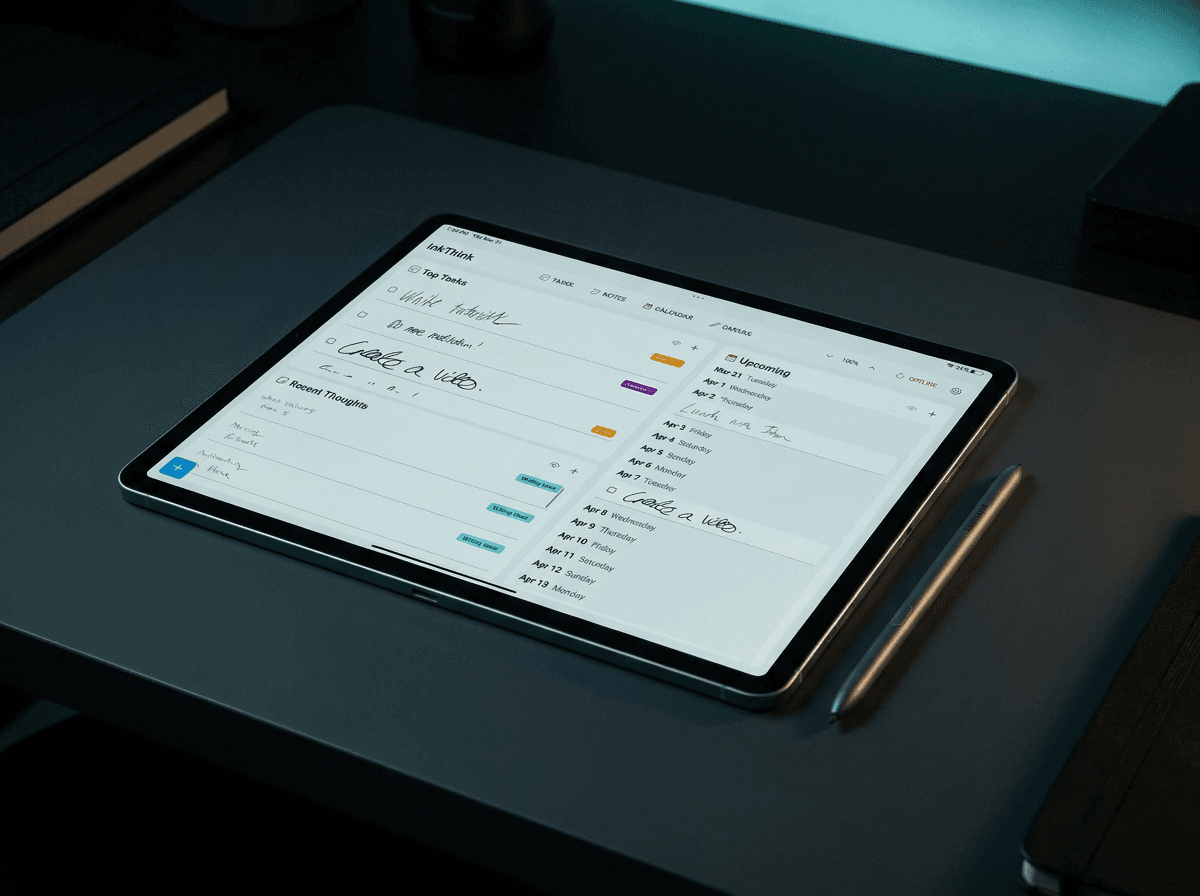
This is the entire reason InkThink exists. Take the part of paper that actually works — the spatial web, the low-friction commitment of pen to page, the way a hand-drawn arrow means something a bullet list never will — and put it in software that doesn't lose it.
What changes when you go from paper to InkThink:
- The web stays a web. A node on the canvas links to another node, converts to a quick note or into a calendar entry. You can rearrange, reflow, and re-thread without starting over. - The "illusion of familiarity" gets broken on purpose. The act of re-reading your own handwriting, weeks later, is humbling in a way a search-and-recall system never is. InkThink keeps your ink in its original form. You see what you actually wrote, not a transcription. - Paper's physical constraint becomes a digital feature. Index cards, sticky notes, margin sketches — InkThink treats all of them as native shapes. You don't have to give up the paper aesthetic to get the digital durability. Your handwriting is your 'signature' and the way you wrote things and the curves and lines convey more meaning than text alone.
## What I'd push back on
I'd add a seventh principle to their six, and it's the one the paper crowd tends to underweight: your thinking should be findable later, not just visible now.
StudyQuest talks about paper as a thinking partner in the moment. That's right. But the half-life of an idea you can't find in six months is zero. The best thoughts I've ever had are the ones I could pull back up two years later and still feel something about. Paper makes the first half work. Software, done right, makes the second half work too.
That's what InkThink is for. The ink stays ink. The page stays a page. But the index card you wrote at 11pm on a Tuesday is still there at 11am the next Wednesday when you need it.
---
If you want the original framework, watch the StudyQuest video — they walk through all six principles in about 12 minutes and the early part on the illusion of familiarity is worth the click on its own. The link is at the top of this post.