Why Schools Should Keep Paper Notebooks in Kindergarten
The tablet rollout in my daughter's kindergarten got me reading the handwriting research again. The case for keeping paper in the early grades is clearer than I expected — and the timing matters more than I thought.

If you read the last post I wrote on this topic, the one about how handwriting lights up the brain in a way typing doesn't, some of this will feel like familiar ground. That post was the headline. This one is the second look — the part I think got lost the first time around. The classroom. The next generation of kids. The part where the research stops being about your own to-do list and starts being about what we're doing to a generation of children who are learning to tap on glass.
The thing the studies keep showing
There's a body of EEG research that's been building since roughly 2017, mostly out of one lab in Scandinavia that has spent the better part of a decade putting 256-electrode nets on people's heads while they write by hand, and then putting the same nets on the same people while they type. The setup is the same. The people are the same. The words are the same. The only thing that changes is whether the letters are formed by hand or by key.
What the nets show, over and over, is that handwriting activates a much larger swath of the brain than typing. Not slightly more. A lot more. The whole brain lights up — sensory regions, motor regions, visual regions, language regions, the parts of the brain that plan and the parts that correct. Typing shows up as a thin band across the fingers. Handwriting shows up as a Christmas tree. That isn't a poetic way of putting it. It's how the researchers describe the visualization. The contrast is that stark.
The explanation is mechanical. When you type, your fingers tap a fixed grid of keys. The movements are simple, predictable, repeatable. After a few weeks of practice, your fingers do it without much help from the rest of your brain. The cognitive load drops to almost nothing. That's the feature. That's why keyboards are good for getting words out fast. It's also the problem: a low-load task produces a low-engagement brain. The neural activity is thin because the activity required to do the task is thin.
When you write by hand, every letter is a small construction project. You're choosing the shape. You're coordinating the fingers. You're feeding back to the eye and adjusting. You're holding the next word in working memory while you finish the current one. There's no way to make that loop efficient. It's supposed to be inefficient. That's the design. The inefficiency is what lights the brain up.
What "lighting up the brain" actually means for learning
Here's the part that matters for kids. The same research group, and others, have run parallel studies in classrooms. They take a group of students learning the same material — vocabulary, letters, math facts, doesn't matter much — and split them into two conditions. One group writes notes by hand. The other types. Then they test both groups a week later, and a month later, and again at the end of the semester.
The handwritten group remembers more. Not slightly more. A lot more, on the kinds of tasks that require retrieval and integration rather than transcription. The typing group is faster — they get more words on the page in the same ten minutes — but a week later they remember less of what they wrote. The relationship holds across age groups. It holds across subjects. It holds for kids who already type fast and for kids who don't.
The mechanism, as far as anyone can tell, is that the slower, more effortful act of handwriting forces the writer to compress and rephrase in real time. You can't write fast enough to capture a lecture verbatim by hand. So you summarize. You paraphrase. You write the example, not the meta-example. You draw a small diagram in the margin. The act of doing that compression in the moment is what cements the material. Typing lets you transcribe. Handwriting forces you to think.
That's not a small difference. That's the difference between learning and recording.
What this looks like in a real classroom
There have been studies. Twenty-two kids. Twelve were on tablets. The teacher was reading a story about frogs. The tablet kids had the story open in a reading app. Some of them were highlighting words. One was playing a math game in a different tab. Two had their screens off and were drawing on the desk with their fingers.
The handwritten kids — the other ten — were doing something different. They had printed worksheets with the story on them. They were circling words they didn't know. One kid was copying a picture of the frog. Another was writing the word "ribbit" in cursive across the top of the page. None of them were on task in the way that the tablet kids were "on task." All of them were paying attention in a way that the tablet kids, by their own later admission, were not.
They asked the teacher afterward what she thought. She said, off the record: "The tablets are great for the kids who already love reading. They're terrible for the kids who don't. And they make it really hard to tell who's doing what." She also said something I keep coming back to: "When they're on paper, I can see them work. When they're on a screen, I see the back of their heads."
The "but they need to learn computers" objection
This is the objection we hear most often from other parents. And it's a fair one. Kids do need to learn to type. They do need to learn to use the tools of the modern workplace. Nobody serious is arguing that we should send kids into the twenty-first century without a keyboard.
But that's not the trade we're being asked to make. The trade we're being asked to make is "handwriting practice time in exchange for screen time." That's a different trade. And the research is pretty clear that it's a bad one — not because typing is bad, but because the time we're spending on typing practice is time we're taking away from the slow, effortful, brain-engaging work of handwriting, and that work is doing something for cognitive development that typing simply does not do.
The answer isn't to ban tablets in classrooms. The answer is to keep handwriting in the curriculum, with the same seriousness we give to reading instruction and arithmetic, until the kids are at least eight or nine and have built the foundational motor and cognitive skills that handwriting builds. Tablets can come in. They should not come in by displacing the thing that builds the foundation.
This is also, not for nothing, the answer that rhymes with what we know about learning to read. Decades of phonics research says that kids need explicit, structured practice with the building blocks of written language before they're ready for fluent reading. We don't replace phonics with "read whatever you want on a tablet" because the research says the explicit practice is what builds the foundation. The same logic applies to handwriting. The slow, effortful, brain-engaging work of forming letters by hand is the phonics of motor and cognitive development. We shouldn't be skipping it.
What they did, and what we'd suggest
Many parents told the teacher they'd prefer their child keep the paper notebooks for kindergarten and first grade, and that we'd revisit tablets in second or third grade once the handwriting foundation is in place. The teachers were visibly relieved.
For other parents who are weighing the same decision, here's the shape of what we'd suggest:
Keep paper notebooks in the early grades. The research on this is unusually consistent. There isn't a serious counterargument from the neuroscience side.
Don't feel guilty about limiting tablet time at school. The school is making the easy decision (tablets are cheaper to maintain, easier to update, easier to standardize), not necessarily the right one.
Make sure the typing instruction happens anyway. There are good free typing programs for kids. The skill transfers easily once the foundation is in place.
If your kid already loves reading on a tablet, that's fine. Reading is reading. The hand-to-paper concern is about writing and note-taking, not consuming content.
If you're a teacher, advocate for paper in the early grades. You probably already know this. The system is just slow to catch up.
The big picture: this is one of those rare cases where the research, the practice, and the common sense all line up. Handwriting builds something in the brain that typing doesn't. We know that. We've known it for almost a decade. The schools are slowly catching up. The parents are catching up faster, mostly because parents can read.
FAQ
Is this research settled, or is it still being debated?
It's settled at the level of the broad claim. Handwriting activates more of the brain than typing, and that translates into measurably better learning and memory in classroom studies. The fine details — exactly which brain regions matter most, exactly how the effect sizes scale by age — are still being refined. But the headline finding has been replicated across labs, across age groups, and across subject matter. The honest answer is "yes, settled, and yes, still being refined at the margins."
What about kids with learning differences or motor difficulties?
The research gets sparser here, but the existing evidence suggests that for kids with motor difficulties, the case for explicit handwriting practice is even stronger, not weaker. The foundation-building effect appears to be larger, not smaller, when the motor system is less automatic. For specific learning differences, the picture is more nuanced — dysgraphia, for example, is real, and the answer isn't to force more handwriting on a kid whose hand hurts. Talk to the school's occupational therapist. Don't generalize from "screen time is bad" to "every kid should write by hand for hours."
Doesn't typing help with spelling and grammar?
Spell-check and grammar-check help with spelling and grammar. Typing itself doesn't. There's no serious evidence that the act of typing — as opposed to handwriting — improves spelling or language skills. If anything, the opposite: the slower pace of handwriting forces the writer to attend to the structure of the word, which is part of why it produces stronger learning.
What about voice dictation?
Voice dictation is a third category, separate from both handwriting and typing, and the research on it is still early. The early signal is that dictation is closer to typing than to handwriting in terms of brain engagement — the cognitive load is lower, the output is faster, the retention is weaker. But the studies are few and the tools are changing fast. I'd treat it as "probably not a substitute for handwriting" but not as "definitely bad."
What about a stylus on a tablet?
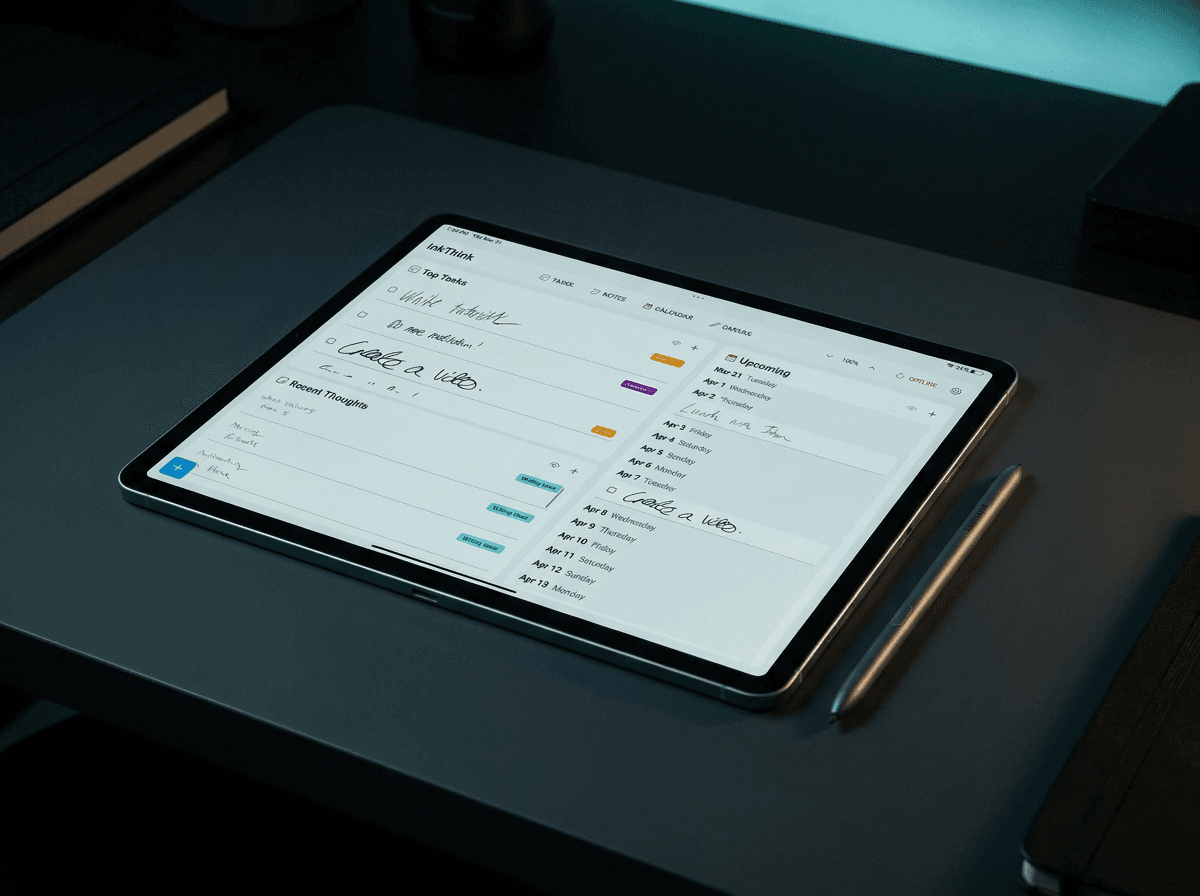
This is the question that gets asked most by readers of this blog, so let me be specific. A stylus on a tablet is closer to handwriting than typing, but it's not the same as handwriting. The kinematics are similar — the hand forms the letter, the sensory feedback is present — but the friction is lower (you can erase cleanly, you can rearrange, you can type to replace), and that lower friction shifts the cognitive load in ways the research hasn't fully tracked yet. The working assumption is that stylus-on-tablet is a partial substitute for handwriting, with most of the upside and some of the downside, and is much better than keyboard-on-tablet for learning. That's the assumption InkThink is built on. But it's an assumption. The research will tell us more in the next few years.
At what age should kids start using tablets for schoolwork?
The research doesn't give a sharp answer, but the practical consensus in the literature is that the handwriting foundation is largely built by age 8 or 9 — late second grade or early third grade. After that, the marginal cost of displacing handwriting with typing drops sharply, and the marginal benefit of digital literacy rises. Before that age, the trade is much less favorable. So: paper in K-2, gradual introduction of tablets in 3-5, full digital workflow by middle school is a reasonable shape.
What if my kid's school is already tablet-heavy?
Push back, gently. The research is on your side. Most teachers know the research is on your side. The schools that are tablet-heavy are usually tablet-heavy for budget and logistics reasons, not for pedagogical ones. A parent who shows up informed, with specific reference to the EEG studies and the classroom studies, can move the needle. You probably won't get the school to abandon tablets entirely, but you can usually get them to preserve paper-based handwriting instruction through the early grades.
Is there a role for handwriting past the foundation years?
Yes — for note-taking specifically. The research on adult note-taking is more mixed, but the consistent signal is that handwriting notes produces better retention than typing notes, even when the typed notes are more complete. This is part of why InkThink exists — to keep the handwriting-as-thinking habit alive on a digital device, well past the foundation years. The brain benefit doesn't disappear at age nine. It just changes shape.
What about kids who hate handwriting?
The effortful nature of handwriting is the point. If it were easy, it wouldn't build the brain. That doesn't mean forcing a kid to write for hours a day — that's not the research either. It means preserving handwriting as one of the modes of learning, alongside drawing, talking, building, and reading, rather than replacing it with a faster, easier mode that doesn't do the same cognitive work. Most kids who "hate handwriting" hate it because they're being asked to do it badly, with the wrong grip, for too long, with no clear purpose. Fix the conditions and the attitude usually follows.
Where can I read the actual studies?
The body of work is open access. The Scandinavian lab has been publishing since 2017, and most of the papers are available without a paywall. The handwriting-vs-typing EEG studies, the classroom studies, the longitudinal work on memory and learning — it's all out there. Search "handwriting EEG learning" or "longhand note-taking retention" and you'll find the relevant papers within a few clicks. I'd encourage any parent or teacher who's serious about this to read the actual sources rather than relying on summaries. The picture that emerges from reading them in sequence is much more compelling than any one paper in isolation.
That's the case, as best I can make it. The research is clear. The schools are catching up. The parents are catching up faster. If you're weighing the same decision as they were — the permission slip, the checkbox, the heavy card stock — I'd say: read the studies, talk to your kid's teacher, and don't be afraid to be the parent who holds the line on paper for a few more years. The brain your kid builds in kindergarten is the brain your kid takes to college. It's worth the friction.