Why Handwriting Is Better for Your Brain Than Typing
The neuroscience is clear: forming letters by hand lights up the brain in a way typing cannot. Here's what the studies show, and what it means for how you work.

I switched to typing everything in college. Notes, journals, to-dos, ideas. By my late twenties my handwriting was barely legible to me, let alone anyone else. I figured that was a fair trade — keyboards are faster, search is built in, nothing gets lost.
Then I started reading the brain research. And it turns out the trade isn't nearly as clean as I thought it was.
There's a body of neuroscience that's been building for the better part of a decade, and the headline is uncomfortable: when you put a pen to paper, your brain does something fundamentally different than when you press a key. The difference isn't subtle. It's the kind of difference that shows up clearly on an EEG net and translates into measurable changes in how well you remember, how well you learn, and how well you think.
I've spent the last few weeks going through the studies and trying them on myself with a stylus and a digital notebook. Here's what the science actually says, what I think it means for how we work, and where I land on handwriting vs. typing in 2026.
The headline finding: your whole brain lights up when you write by hand
The studies I'm referencing used EEG nets with 256 electrodes to measure surface brain activity, then inverse mathematical models to trace that activity back to where it originated in the brain. The setup is rigorous. The participants included both university students and 12-year-old children. The conditions were controlled: in one task, people were given a word — "hedgehog," "umbrella," "friendship," "birthday" — and asked to either draw it, write it by hand, type a description, or type the word repeatedly with one finger.
The result, replicated across multiple studies since 2017: handwriting and drawing activate the brain at a much larger scale than typing. Not a little. A lot. The kind of "wearing a party hat" activation that you can see on the head model and don't need a PhD to interpret.
Typewriting, by contrast, produced a much narrower activation pattern — basically the same simple finger movements repeating for every letter. The brain wasn't doing much.
Why typing is so much less for your brain
Here's the mechanical difference. When you type the word "birthday," your fingers hit b-i-r-t-h-d-a-y. Each keypress is essentially the same motion. The motor pattern is uniform. Your brain doesn't have to know what letter it's producing — your fingers just walk across the keyboard.
When you write the word "birthday" by hand, your fingers and hand produce a unique motor pattern for every single letter. The b requires a totally different motion than the d. The y has a descender. The t crosses the stem. Each letter activates different sensory and motor areas, and your brain has to coordinate all of them in real time.
That coordination is the point. It's not the words on the page that do the work. It's the work of producing the words.
The study on connectivity is even more striking. When participants wrote by hand, the brain showed broad cross-communication between many active areas. When they typed, the brain's active areas were far more isolated from each other. Less talking between regions. Less integration. The brain was working locally instead of holistically.
What this means for memory and learning
The reason this matters isn't just "your brain is more active." Your brain being more active is, in a meaningful sense, the whole point of learning.
When more regions are engaged, they need to communicate. That communication is what gets encoded as memory. When only a narrow band of motor areas is engaged, the encoding is shallow. You might remember the gist. You don't remember the texture.
This is also why children who learn to read and write on a tablet have trouble differentiating between letters that look similar — b and d, for example. They haven't felt with their bodies that producing a b is mechanically a different act than producing a d. The letters are visually distinct to them, but kinesthetically identical. So the deeper memory — the one tied to the motor act of writing — never forms.
For adults, the same principle applies at a different scale. The hand-written note doesn't just record the meeting. The hand-written note is part of how you have the meeting. The motor act is doing cognitive work that pressing a key doesn't.
The "but I have to use a tablet" objection
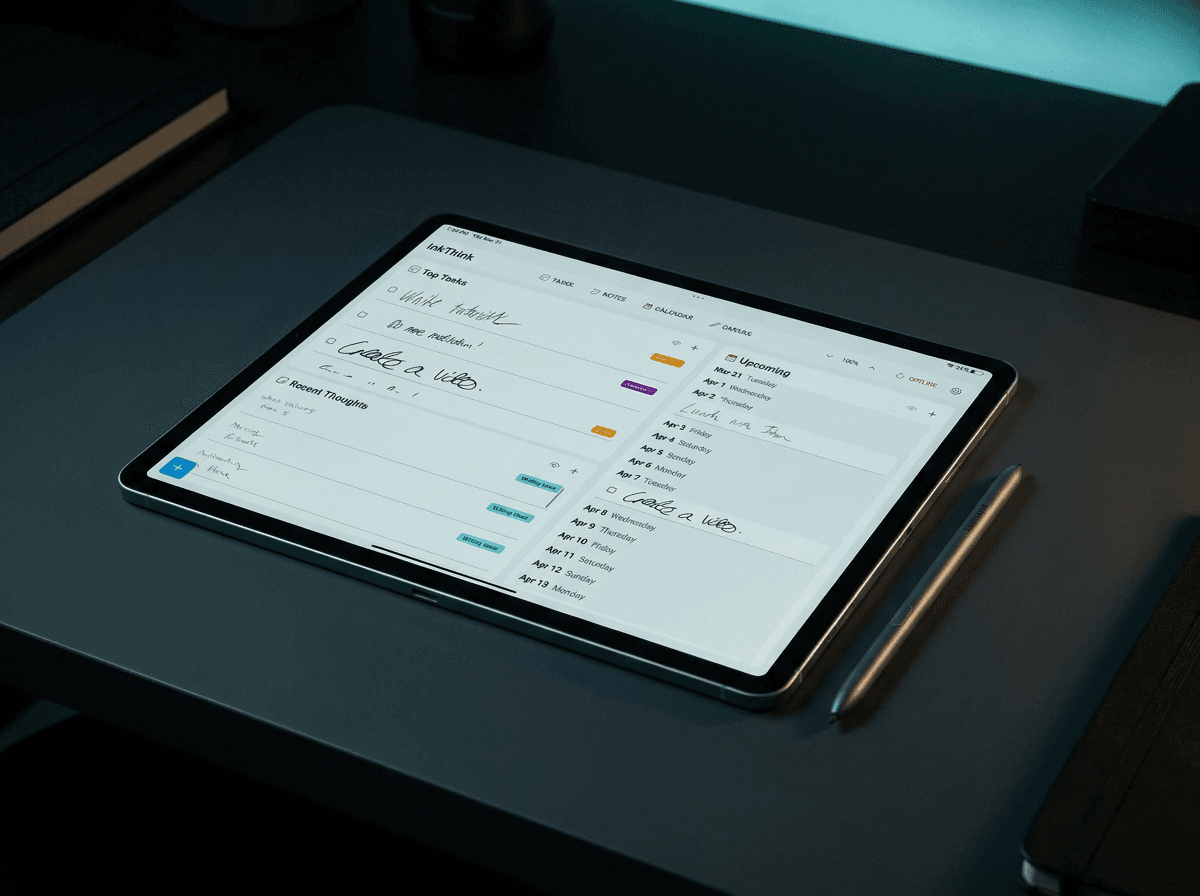
I get it. Most of us aren't writing on paper anymore. We're writing on a Boox, a reMarkable, an iPad with a stylus, a Surface. The argument from the brain research, though, is that drawing or writing by hand — using your hand to produce forms on a surface — engages the brain the same way regardless of whether that surface is paper or a touchscreen. The hand does the work. The brain lights up.
That's why the InkThink workflow looks the way it does. The point isn't the notebook. The point is the hand. I write on a digital surface because I want search, backup, and the ability to shift things around. But the writing itself — the act of forming letters with a stylus — is the thing that's doing the cognitive work.
If you're using a stylus like a keyboard — if you're just tapping a text field and "writing" feels like typing in cursive on a screen — you're not getting the benefit. The benefit is in the motor pattern of forming the letters, not in the input device recording them.
So what do I actually do with this?
A few concrete changes I've made, in order of how much they matter:
Meeting notes go on a tablet with a stylus, not on a laptop keyboard. Same content, dramatically different cognitive load. I remember more of what was decided and more of who said what.
First drafts of anything important start as handwriting. Not because the digital version is hard — because the first draft is where I'm thinking, and the hand helps me think.
Reading notes I want to remember are handwritten, not highlighted. Highlighting is selection. Writing is generation. The latter sticks.
I keep a small paper notebook for the kinds of things I would otherwise forget by lunch. Errands, ideas, names. The act of writing them down is the memory aid. The paper is the side effect.
I haven't gone back to paper as my primary surface. The search and the cross-linking still matter too much to me. But the stylus and the digital notebook aren't a compromise — they're a way to keep the cognitive benefit of handwriting without giving up the things that make digital useful.
What about the kids?
This is where the research gets a little more charged, and I think it's worth saying directly: the recommendation coming out of the Norwegian research groups is that primary schools should have a minimum of handwriting instruction. Not because handwriting is a charming cultural artifact. Because for the developing brain, the motor act of forming letters is doing real neurological work that nothing else does.
For adults, the stakes are lower. Your brain is already developed. You're not going to fundamentally rewire yourself by switching to handwriting. But the research is clear that the difference in cognitive engagement is real and measurable, and that translates to small but real differences in memory, comprehension, and idea-generation in the moment.
If you're a writer, a student, a researcher, a designer, or anyone whose work is "think about things and produce something" — that's most of us — those small differences compound.
The bottom line
The case for handwriting in 2026 isn't nostalgia. It's that the act of writing by hand engages the brain in a way that typing literally cannot, and that engagement shows up in the things we care about: memory, learning, the quality of our thinking, and the kinds of ideas that come out the other side.
You don't have to throw away your keyboard. You don't have to go back to paper. You do have to pick up a stylus and use your hand to form the letters.
Your brain will know the difference.
FAQ
Does writing on a tablet with a stylus count as "handwriting"? The brain research suggests yes — the activation patterns are similar to paper-based handwriting, as long as you're actually forming the letters with the stylus rather than tapping a text field. The hand does the work; the surface is incidental.
Is this only relevant for kids whose brains are still developing? The research is strongest for developing brains, but the activation differences show up in adults too. For adults the practical effects are smaller but real: better encoding of new information, more integrated thinking, more recall.
What if my handwriting is bad? The brain doesn't care. The motor act of forming letters is what's doing the work, not the legibility of the output. Sloppy handwriting still produces the broad activation pattern. Worry about content, not penmanship.
How long does the effect last after you switch back to typing? The studies measure the effect during handwriting. There's some evidence that regular handwriting use has a longer-term effect on how well you remember and integrate new information, but the strongest claim is about the in-the-moment engagement, not a permanent rewiring.
What about dictation? Dictation removes the hand entirely. The research is clear that the hand is doing real cognitive work, so dictation should be expected to land somewhere between typing and handwriting in terms of engagement — closer to typing. Useful for capture, less useful for thinking.
Is there a downside to handwriting? It's slower. It's not searchable. It's harder to edit. The trade is real. The point isn't that handwriting is always better — it's that the cognitive cost of typing is invisible, and the cognitive benefit of handwriting is invisible. Once you see both, the trade looks different.
What's a practical way to start? Pick one category of notes you currently type and move it to a stylus-based notebook. Meeting notes is the easiest place to start because the content is short and the cognitive payoff is high. Give it two weeks before you judge.
Does this apply to drawing and sketching too? Yes — drawing and handwriting activate similar brain patterns, which is why sketch-noting and visual thinking get the same cognitive benefit. The hand is doing intricate motor work in both cases.
Is this just one study or is the evidence strong? Multiple replications since 2017, including both university students and children, with controlled conditions across drawing, handwriting, and typing. The activation differences are large enough to be obvious on the head models, not just statistically significant. The evidence is solid.
Should I drop my keyboard for a stylus entirely? Probably not. Typing is faster for capture, and not all thinking benefits from slower motor engagement. The principle is to match the tool to the task: handwriting for the parts of the work where thinking matters, typing for the parts where capture matters.