17 Ways to organize your thoughts
Seventeen ways to get the swarm out of your head and onto a surface you can work with — practical, creative, thoughtful, and physical methods for the stylus era.

I keep a small notebook by my bed. Not because I'm precious about paper — I write on a tablet most days — but because the first ten minutes of every morning, before the tablet is awake and the stylus is charged, is when my brain is loudest. Ideas tumble out: half-formed blog post angles, weird product ideas, that thing I forgot to tell my mom, the name of the restaurant someone mentioned at dinner three weeks ago. If I don't catch them, they vanish. If I do catch them, they sit there waiting for me to do something with them.
That's the whole problem with thoughts, isn't it? They're not things. You can't put them on a shelf. You can't forward them to yourself. They live in your head like loose change at the bottom of a bag — present, vaguely annoying, impossible to spend until you sort them. And the longer you leave them, the more they multiply, and the more they multiply, the more your head feels like that bag after a trip.
I've spent years trying to find a system that works for this. Not a productivity system — a thinking system. Something that helps me go from "my head is full of stuff" to "okay, I see what I'm supposed to do next." Some days I want structure. Some days I want my hands busy. Some days I want to sleep on it. The method changes; the goal doesn't. Get the thoughts out of your head and into a form you can work with.
Here are seventeen ways to do that. Most of them work just as well with a stylus as they do with a pen. Pick the one that matches the kind of brain weather you're having that day.
Why bother organizing your thoughts at all?
A thought you can't act on is just noise. A thought you can act on — that's a plan. The act of organizing isn't about tidiness. It's about turning a swarm of half-formed ideas into a small list of things you can actually pick up tomorrow morning and do.
The practical upside is huge. You'll plan your day better. You'll stop dropping balls. You'll know what to delegate and what to keep. You'll free up the mental bandwidth you were spending trying to remember the things you were trying to remember. The emotional upside is bigger: you'll feel less behind.
When to do it
There's no wrong time. First thing in the morning works — your brain is loudest before you've poured it into anything else. Mid-afternoon works — that's when the morning's decisions start to compost into something you can sort. Even late at night works, if you're the kind of person whose best thinking happens when the rest of the house is quiet.
The trick isn't the time. The trick is making it a habit. Same time, same place, same tool. My tablet wakes up the same way every morning. Yours can too.
Practical ways to organize your thoughts
These are the methods I reach for when my head feels like a desk that's been hit by a small tornado. They are fast, structured, and they work even when I'm not in the mood for anything fancy.
Sticky notes on a wall
One thought per sticky. Stick them on the wall. Keep going until the wall is full or your head is empty, whichever comes first. Then take three big steps back and look at the whole field. Patterns jump out at distance that you can't see up close. Group the notes. Throw away the ones that don't belong with anything. What you have left is the actual shape of what's been bothering you.
The reason this works: it forces you to commit each thought to a single, concrete artifact. A page covered in prose is still a soup. A wall of one-thought-per-sticky is a constellation. And of course using a large whiteboard on your wall is similar.
Draw a mind map
Center thought in a circle. Branches radiate out. One branch per related idea. Sub-branches for the related ideas that hang off those. Don't worry about making it pretty — mind maps that look like engineering diagrams are usually mind maps that never got finished.
On a tablet, this is where a stylus earns its keep. The shape of the lines matters less than the fact that the lines exist at all. A thought on a branch is a thought that's been given a neighbor, and neighbors are how patterns get born.
Index cards
Same idea as the sticky wall, but smaller and stackable. Write one thought per card. Shuffle them. Reorder them. See what new combinations appear when the cards aren't in the order you originally thought of them in. The shuffle is the point — fresh arrangements produce fresh insight.
If you don't have physical index cards, a tablet with a one-thought-per-page template works the same way. Just don't try to fit two thoughts on one page. The constraint is the tool.
Make a list
The simplest thing in the world. One thought per line. Write until you can't think of anything else. Then look at the list. What repeats? What's actually one thought in two different outfits? Where are the lines you can connect?
The list is the most underrated thinking tool we have. People dismiss it as too simple. That's exactly why it works. There's no system to learn. There's nothing to fail at. There's just the next line.
Pie chart it
If your thoughts cluster into obvious categories — work, family, that one big project, the run of small admin tasks — draw a circle and partition it. Make the slices proportional to how much mental space each category is actually taking up. Not how much you wish it were taking up. The actual share.
Most people are surprised by what the chart reveals. The thing they thought was eating 20% of their head is eating 60%. The thing they thought was a crisis is a sliver. The pie doesn't lie.
Creative ways to organize your thoughts
Sometimes the structured methods feel like they're forcing the thoughts into shapes they don't actually have. That's when you switch to creative methods. The point of these is to trick your brain into looking at the same set of thoughts from a different angle.
Handwrite a letter
To someone you trust. Not to send — for your eyes only. Start with "Hey, so here's what's been going on in my head." Then keep going.
The trick is the audience. Writing for yourself lets you ramble. Writing for someone else forces you to organize — what would you actually tell them first? What context do they need? What's the point you want them to walk away with? That structure, even in private, is what untangles the knot.
Make a collage
Cut out images, words, colors, shapes that match the vibe of what you're trying to sort. Glue them onto a board. Step back.
On a tablet this is faster than it sounds. Pull images from your camera roll. Drop them into a page. Resize. Move them around. The collage doesn't have to mean anything literal. It just has to be a different surface for the same thoughts to land on. Different surfaces produce different insight.
Write a table of contents
Pretend all your thoughts are chapters of a book. What comes first? What's in the middle? What closes the book? Write the table of contents out.
This is one of the most underrated methods I've found. It forces you to commit to an order. Once you've said "Chapter 1 is this," everything else has to find its place relative to that. The act of choosing the first chapter usually reveals which thought is the loudest one — and that's the one you need to deal with first.
Build a timeline
Lay your thoughts out along a horizontal line. Today on the left. Next week. Next month. Next quarter. Place each thought in the slot where it actually belongs, not where you wish it belonged.
The timeline reveals two things: which thoughts are time-sensitive (and need to move first) and which thoughts are evergreen (and can wait until the time-sensitive ones are done).
Record yourself
Open the voice memo app. Talk for ten minutes. Don't edit. Don't pause. Just say whatever comes.
Listening back is where the magic happens. You'll hear the thought you actually keep circling back to — usually three or four times in those ten minutes — which is the thought you've been avoiding naming. Once it's named, you can deal with it.
Thoughtful ways to organize your thoughts
Not every thinking tool is a writing tool. Sometimes the best way to organize a thought is to stop actively thinking about it and let your subconscious do the work.
Work on a repetitive task
Wash the dishes. File the papers. Enter the receipts. Anything that occupies your hands without occupying your mind.
The reason this works is that active thinking is loud. It drowns out the quieter, slower thoughts that are usually the more important ones. When your hands are busy, your mind gets a quieter room to work in. Most of my best insights about a problem have arrived mid-dishwashing.
Sit quietly
Five minutes. Lights off. Phone in another room. Sit.
If you have a meditation practice, use it. If you don't, just sit. The first minute is uncomfortable. The second minute is worse. By the third minute, your brain usually starts to deliver the thought it was waiting to give you. It just needed the quiet room.
Sleep on it
Sometimes the right answer is to put the problem down and pick it up in the morning.
Sleep is one of the most powerful thinking tools we have, and we treat it like downtime. It's not downtime. It's the thing your brain does when it stops actively managing the world. Most decisions that felt impossible at 11pm feel obvious at 7am — not because you slept on them, but because your brain did.
Physical ways to organize your thoughts
If the thoughtful methods are about quieting your mind, the physical methods are about jiggling it. Getting the body moving often unlocks thoughts that the brain was holding onto.
Get some exercise
A walk. A run. Some stretches. Even ten minutes.
The mechanism is the same as the repetitive task, but stronger. Movement changes your blood flow, which changes which neural circuits are online, which changes what your brain decides to work on. Most of my best product thinking happens in the first fifteen minutes of a walk, before the walk becomes routine.
Spend time in nature
Different from a walk. A walk can be through a shopping mall. Nature means trees, sky, no phone signal, no people watching you.
The default-mode network — that's the part of your brain that does the slow, integrative thinking — activates more reliably in natural settings than in urban ones. The research is real. The experience is realer.
Talk to a friend
Not to ask for advice. To narrate what's going on.
The narration does the organizing. By the time you've explained the situation to another human, you've usually figured out what you actually think. The friend doesn't have to say anything useful. They just have to listen.
Tell a story
Pretend the situation you're sorting out is a story. Who are the characters? What's the setup? What's the conflict? How does it resolve?
Stories have structure. Real life often doesn't. Forcing your situation into a story shape forces you to identify the through-line, the moment it turned, and the moment it ended. If you can tell the story, you can usually find the next move.
How to choose the right method for you
If your thoughts feel scattered and you need structure fast, go practical. Sticky notes or a list will give you the most clarity in the least time.
If the practical methods aren't working and the thoughts keep slipping out of every container you put them in, go creative. The collage or the table of contents will give your brain a different surface to land on.
If you're not in the mood to actively think at all, go thoughtful or physical. Sleep, walk, sit. Let the subconscious do the work.
The method matters less than the doing. Pick one. Do it today. Tomorrow, if it didn't work, pick a different one. The point isn't to find the perfect system. The point is to stop walking around with a head full of things that are slowly turning into stress.
FAQ
Why should I take time to organize my thoughts at all?
Because thoughts you can't act on are just noise. Organizing them turns the noise into a small number of things you can pick up and do. The clarity payoff is huge — better planning, fewer dropped balls, less background stress about things you can't quite name.
How do I choose the best method?
Match the method to the kind of brain weather you're having. Structured brain? Practical methods. Stuck brain? Creative methods. Tired brain? Thoughtful or physical methods. None of them are objectively better than the others — they're different tools for different days.
When is the best time to organize my thoughts?
Whenever you'll actually do it. Most people have the most luck first thing in the morning, before the day's decisions start to layer on top of the underlying stuff. Late at night also works for the reflective types. Mid-afternoon can work if you treat it as a deliberate ritual rather than something that happens to you.
Can physical activity really help me think?
Yes — and not in a vague "movement is good" way. Exercise changes which neural circuits are active, which means it changes what your brain decides to work on. Most people have had the experience of solving a problem in the shower or on a walk that they couldn't crack sitting at a desk. That's not magic. That's the brain getting a different room to work in.
Do creative methods like the collage actually work?
Yes — but they work differently than the practical methods. The practical methods force clarity by giving each thought its own clean container. The creative methods force clarity by giving your brain a different surface to land on, so the same set of thoughts gets seen from a new angle. You don't need to be artistic. You just need to be willing to play.
What if I try a method and it doesn't help?
Try a different one. The first method you reach for doesn't have to be the one that works. The point is to keep moving thoughts out of your head and into some form you can work with — the form doesn't matter as much as the moving.
How often should I do this?
Daily if you can. Even five minutes. The habit matters more than the duration. A two-minute daily clearing is worth more than a two-hour monthly one.
What if my thoughts don't fit neatly into a list or a chart?
That's exactly when the creative and thoughtful methods earn their keep. Mind maps and collages accept mess. A walk accepts mess. Sitting quietly accepts mess. You don't have to be neat to be organized.
A final note
The reason I built InkThink was this exact problem. I was carrying too many loose thoughts in too many places. A notebook for this. A notes app for that. A whiteboard for something else. Nothing talked to anything. None of it was portable. None of it gave me the one thing I actually wanted, which was the next thing to do.
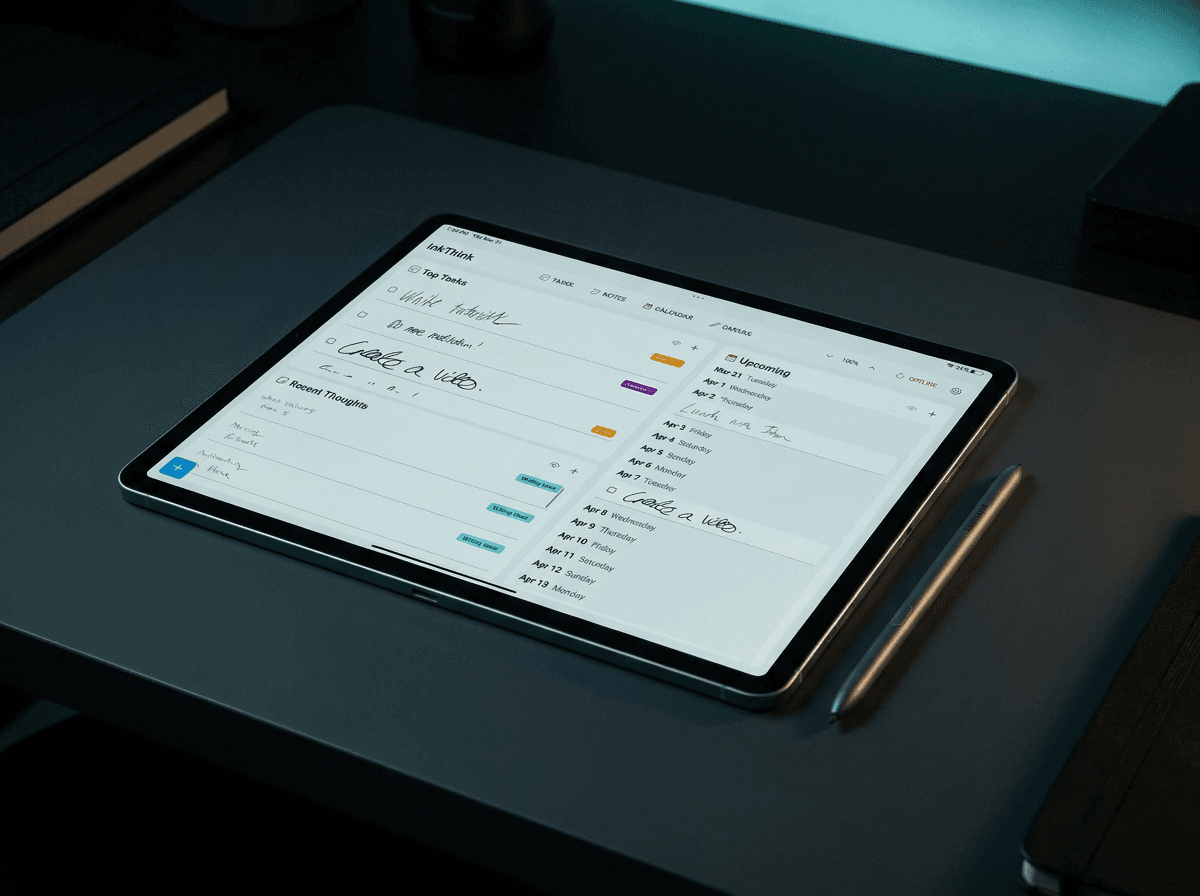
InkThink is the stylus-first digital planner for people whose thoughts live in more than one place. NoteDex, our sister app, is for people who want a single connected notes-and-tasks system. They think together. Whatever method you use from the list above — sticky wall, mind map, table of contents, walk — InkThink is the surface where the sorted thoughts land and become plans.
Try one method today. Just one. Pick the smallest thought in your head and put it somewhere it isn't your head. See what happens.