5 Minutes of Ink Beats 5 Hours of Productivity Porn
Most productivity advice is productivity porn — rituals built to feel like work. The minimum viable task review is 5 minutes a day. Ink forces the re-read that makes those 5 minutes stick.

I spent a year optimizing my task manager. Color-coded labels. Smart filters. Recurring templates that auto-populated. The whole thing looked like a productivity influencer's dream setup. And I was getting less done in a week than I do now in a day with a pen and a one-page template.
The hard part of productivity isn't the system. It's the gap between the system and what you actually remember. And that gap is exactly where the ink goes.
The cult of the 5am morning routine
Open any productivity feed and the message is the same: wake earlier, plan harder, optimize deeper. The implicit promise is that the right system will replace the friction of deciding what to do next. If you can just build the perfect Notion template, the FAQ says, the days will run themselves.
This is wrong. Or at least, it's wrong for anyone whose brain doesn't generate friction-free decisions on demand. The premise that "more organization = more done" treats your task list like a math problem. Add more entries, get more output. But the bottleneck was never the list. It was the review — the small, deliberate moment where you actually look at what moved yesterday and decide what gets to move today.
Watching a productivity YouTube creator talk through his system this week confirmed it. He called the genre "productivity porn" — the rituals and templates built to feel like work. Two pillars, he said: a notes app and a task manager, used 5 to 30 minutes a day. That's the whole system. Not eight hours of templates. Five to thirty minutes of review, repeated daily.
Most people stop there. The 5-minute daily review is the system. But "5 minutes" is doing a lot of work in that sentence. Five minutes of what, exactly? Five minutes of skimming a list on your phone while the kettle boils? That kind of review doesn't stick. It doesn't create memory. By the time you finish your coffee, you've forgotten what you decided.
The minimum viable review: pen, paper, three lines
The Lawley system as defined by Christopher Lawley in his YouTube video is, at its core, a daily review habit. You open your task list. You look at what's scheduled. You decide what gets to move. Five minutes. The cadence is the genius — it's small enough to actually do, and it's frequent enough to keep the system honest.
But the medium matters more than people admit. Most reviews happen on a screen. You scroll through a list, you check a few boxes, you swipe back to whatever app you were in. The review is a passive consumption event. Your brain doesn't commit to anything because nothing physical happened.
The fix is stupidly simple: write the review down. Three lines on a paper page, or three lines on a tablet with a stylus. Doesn't matter which.
The three lines:
Three things that moved yesterday. Not a recap. Just the things that actually moved. Phone calls returned. Snippets drafted. Decisions that unblocked other decisions.
Three things moving today. The ones that, if they get done, make the day feel like it happened.
One thing to defend against. The interruption, the meeting, the Slack channel that always tries to eat the morning. Name it. Defend against it.
That's the whole review. Three lines. Five minutes. Done.
Why the ink forces the re-read
Here's the part nobody talks about. When you write yesterday's three things by hand, you can't skim them. You actually have to think them. The pen slows you down to the speed of recall. Your brain reaches back through the day and pulls out what mattered. That small act of retrieval is the entire cognitive payoff of the review.
It's the same reason students who handwrite notes outperform students who type them in every study I can remember. The friction of forming letters is the friction of forming memory. Apps that promise "AI organizes everything" are trying to remove that friction. They're hoping, I think, that the system will be so good you don't have to remember anything yourself. But the system isn't the product. The remembering is the product.
Pencil-to-paper especially has a property that no app has replicated: the unfinished sentence. You start writing "Responded to Maya about the…" and your brain has to think about what came next. The pen is still moving. The sentence is incomplete. Your brain is forced to complete it. That pause — that small creative act of remembering — is what builds the next day's review. Without it, the review is just a checklist. With it, the review is a memory test.
This is also why stylus-on-tablet works. The friction is the same. The motor memory is the same. The retrieval is the same. You don't need a Moleskine. You need a surface that resists your hand just enough to slow the gesture down.
Apps that promise to organize everything — and the friction they erase
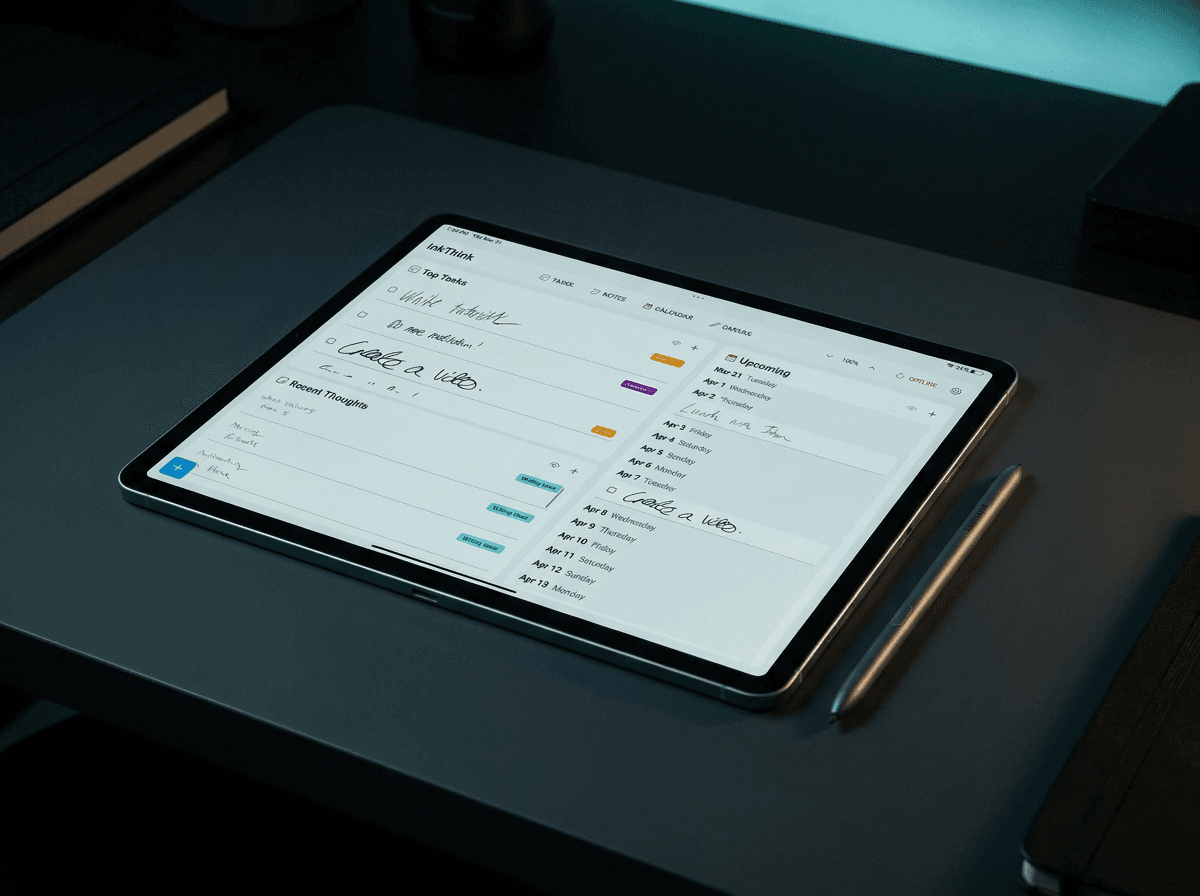
I run InkThink, so I have a strong opinion here. The pitch of every productivity app is the same: we'll do the organizing for you. AI will tag your tasks. AI will surface the urgent ones. AI will tell you what to work on next. The promise is relief from the cognitive load of deciding.
But the cognitive load of deciding is the work. The review — the small, daily, slightly annoying act of looking at what you said you'd do and what you actually did — is the practice. It's the reps. It's the muscle that gets stronger every time you do it. Outsourcing that practice to an app is like outsourcing a workout to a machine that moves your arms for you. You'll get the calories burned, but you won't get the strength.
A stylus-first planner like InkThink doesn't try to be smart. It stays out of your way. You write your three lines. You re-read yesterday's three lines. You either check one off or you don't. The app doesn't rank your tasks for you. It doesn't surface them. It doesn't remind you. It just holds the page. The cognitive work stays with you.
The 3-step daily review (the only one that stuck for me)
After a year of trying every review format, this is the one I actually do. Every morning. Five minutes. Not negotiable.
Step 1 — Pen, InkThink open, look at tasks with due date yesterday, mark off any completed.
Step 2 — Re-read three tasks still pending out loud. Quietly, to yourself, in your own voice. Don't skim. Read them. The point is the retrieval, not the recap. The point is to remember that you said you'd do certain things and to notice which ones moved.
Step 3 — Update today's three tasks, maybe they are the same or maybe you need new ones. That's it. The constraint is the point. The nice thing about InkThink is that if you have set a due date it will automatically 'roll-over' the due date so you don't need to change that! A little technology touch to remove friction. Allows you to look at your tasks and see what needs to be done.
Five minutes. Done. The next day, you do it again. The day after that, you do it again. By the end of the second week, the review is the foundation of the day. By the end of the month, it's the foundation of the week. By the end of the quarter, the system is invisible because the practice is automatic.
The reframe: ink keeps the friction where it matters
Productivity porn sells the fantasy of frictionless organization. The implicit promise is that you can build a system so good you never have to think about it. But that promise is also a trap. The thinking is the work. The friction is the memory. The 5-minute review is the productivity.
The minimum viable task review is real. It's the only system that actually scales. But the medium matters. Whether you write it in a paper notebook or on a tablet with a stylus, the ink is what's doing the work. The ink is what forces the re-read. The ink is what makes the review a memory instead of a scroll.
So if you've been optimizing your templates for an hour a day and still feel like the days blur together, try the opposite. Close the templates. Open the page. Write three lines. Five minutes a day. Let the ink do the work.
InkThink is one-time purchase, no subscription, your notes stay yours. The whole app is built to get out of your way while you do the only thing that actually works — the daily review. Try it free for a week and see.
Frequently asked questions
What if I miss a day?
Don't restart. Just do today's review. The review isn't a streak. It's a practice. A missed day is just a missed day. The next day's review is the practice. Most people who quit journaling, planning, or reviewing did so because they broke the streak once and decided they had to start over. The reframe is: the streak is the failure mode. The practice is the goal.
Five minutes feels too short. Should I spend more time on it?
Try five minutes first. If you find yourself consistently wanting more time, push to seven. Most of the value of the review is in the constraint. The moment you let the review become 30 minutes, it becomes a system to optimize instead of a practice to maintain. The 5-minute cap is the discipline.
Why not just use a paper notebook?
Paper is great. Use it if it works for you. The reason I built InkThink is that I wanted the friction of ink with the durability of a digital file. My paper notebooks got lost. My handwritten notes on a tablet don't. The cognitive practice is the same. The storage is just better.
What if I don't have three things that moved yesterday?
Then write down what didn't move. The review isn't a brag. It's a checkpoint. The point is the act of looking at the day, not the content of the day. Some days you moved three things. Some days you moved nothing. The review still works either way. The next day will be different.
Isn't this just a fancy to-do list?
No. A to-do list is forward-looking. The review is both directions. It looks backward at what actually happened and forward at what's next. The combination is what's missing from most task systems. They're all forward-looking. None of them make you look back. The look-back is what makes the next day smarter.
Do I really need a stylus and a tablet? Can't I just type this on my phone?
You can type it. You'll probably skip the review by day four. The friction of typing is the wrong kind of friction — it's friction of formatting, not friction of recall. The motor memory of writing letters is what triggers retrieval. Typing letters doesn't. The difference is small but proven across decades of research. If you want the practice to stick, ink.
What if my daily review is just three lines of "I don't know"?
Then write that. "I don't know what moved yesterday." The act of writing the sentence is the practice. The content catches up. Mostly what the "I don't know" days reveal is that the day was actually full of small movements you didn't notice — a conversation that mattered, a decision that unblocked something, a piece of work that got nudged forward. The review surfaces those. You don't have to surface them on day one.
Does this work for ADHD brains?
Honestly, the 5-minute cap is what makes it work for ADHD. Big systems fail ADHD because big systems require sustained attention. Small systems work because they require the minimum viable attention. The constraint is the design. If 5 minutes is too long, try 90 seconds. The shorter, the more likely you'll do it. The more you do it, the more it compounds.
Where does the weekly review fit in?
After about a month of daily reviews, you'll start to notice patterns. The same tasks keep showing up. The same projects keep moving. The same interruptions keep trying to eat your mornings. That's the signal for a weekly review. Take 30 minutes on Sunday. Walk through the week. Decide what's still alive. Decide what to kill. The weekly review is the project-by-project sweep. The daily review is the day-by-day checkpoint. You need both. But the daily one has to come first.
Anything else I should know?
Yes. The system is not the point. The review is the point. The system is just the scaffolding that holds the review in place. If you find yourself optimizing the system more than doing the review, the system has become the productivity porn. The review is what builds the career. The system is what holds the keys to the door.
— Prem, Creator of InkThink
Source: Christopher Lawley — "My Task & Project Management System"