3 Cognitive Habits of People Who Get Things Done
Researchers who study accountability found three quiet cognitive moves behind every reliable shipper. They're not about discipline or focus — and almost every productivity tool ignores them.

I used to think getting things done was a motivation problem. If I could just be more disciplined, more focused, more on, the tasks would fall into place. So I'd plan harder. Buy another notebook. Try a new app. Block off a perfect Sunday morning to "really get after it."
Two hours later, the notebook was open, the task list was written, and I was still staring at the ceiling.
That ceiling-staring phase is where most of my planning apps, todo systems, and color-coded weekly spreads went to die. Not because the tools were wrong. Because the cognitive habit underneath them was missing. Researchers who study accountability and execution have spent years reverse-engineering what makes some people ship and other people stall. What they found isn't about willpower or hacks. It's about three quiet mental moves that almost nobody talks about — and almost every productivity tool ignores.
If you've ever closed a planning session feeling like you did a lot of work and made zero progress, these three habits are the reason. And once you see them, you'll spot them in every genuinely productive person you know.
The hidden architecture behind people who actually ship
A few years ago, a team at a neuroscience-focused research outfit decided to study the people on every team who somehow always got things done. Not the loud ones. Not the ones with the longest to-do lists. The ones whose work you could count on without checking. The Jennifers of every office — the person you stop worrying about because you know it will land.
They asked a deceptively simple question: what is actually happening in their head? Not in their calendar. Not in their app. In their head.
Three cognitive habits kept showing up. And here's the part that matters for anyone who plans on paper or on a tablet: these habits aren't time management. They're clarity management. They happen before the task hits your list, and they're why the right side of the list actually moves.
The three habits are:
Sync expectations — get explicit on what done looks like.
Drive with purpose — connect every task to an outcome that matters to you.
Own your impact — look honestly at what your work produced, not what you intended.
Let's walk through each one, and what it looks like on a real planning surface.
Habit 1: Sync expectations — kill the "I thought we meant…" moment
The fastest way to feel productive and ship nothing is to do a task you didn't quite understand. You write "Q3 deck" in your planner. You sit down. You make slides. You feel busy for two hours. Three days later, your boss says "yeah, that's not what I meant" and you have to start over.
That whole arc — the busy two hours, the rewrite, the loss of trust — is a single failure of expectation sync. You and the requester had two different versions of "done" in your heads, and you only found out when it was too late.
The neuroscience of this is well-documented. When the brain holds two different expectations and one of them fails to land, it processes the gap as an error signal. Motivation drops. Frustration spikes. Trust with the other person degrades. That's not a motivation problem to white-knuckle through — it's a wiring problem you have to solve upstream, before the work begins.
What "syncing expectations" looks like in practice:
Before you start a non-trivial task, write down what done looks like — in one sentence. "Done = the deck is ready to send to the leadership list by Thursday 5pm." Not "work on the deck."
For any task involving another person, write down what they think "done" is, separately from what you think. If those two sentences differ, the work hasn't started yet.
For solo tasks, the standard is the same. "Done = the weekly review is written and saved in the Weekly folder, not just typed into a draft."
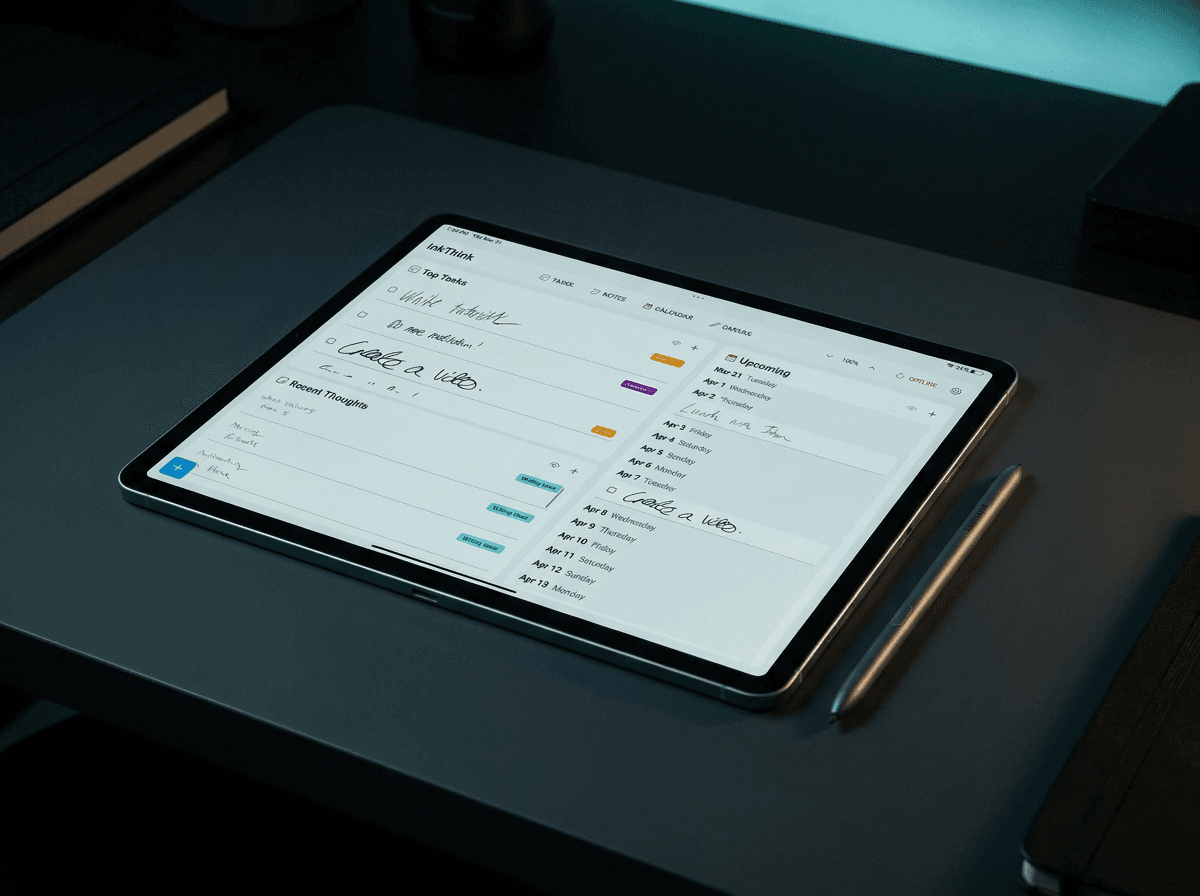
This is exactly the kind of habit a digital planner rewards. On paper, you'd scribble "Q3 deck" and move on. In InkThink, you can give the task a real Done line — a specific deliverable, a specific destination, a specific moment. The act of writing it makes the gap visible. You can't un-see "Q3 deck" once you've defined what shipped actually means.
Habit 2: Drive with purpose — every task needs a why that's actually yours
The second habit is the one that separates busy from productive. A busy person has a list of tasks. A productive person has a list of tasks connected to outcomes they care about.
This isn't a pep talk. There's a real reason it matters. The brain's effort system runs on a sense of why this matters. Tasks that are clearly connected to a goal you chose light up the same circuitry as something you'd do for free. Tasks that feel imposed — even if you imposed them — get done slowly, resentfully, and badly.
The trap is that most planning systems treat every task as equally important. Your weekly review sits next to "renew driver's license." Your Q3 deck sits next to "water plants." On the page, they're peers. In your head, they're not, and pretending they are leaves you exhausted by Friday.
Driving with purpose means: for each task you actually intend to do today, name the outcome it's serving. Not the task — the outcome.
"Reply to client email" → outcome: keep the project on schedule and avoid a Monday morning scramble.
"Plan next week's content" → outcome: have something to write when the writing block starts so I don't lose 30 minutes to "what should I write".
"Water plants" → outcome: don't kill the basil, again.
The basil example is not a joke. Purpose isn't only for big strategic work. If you can't name an outcome — even a small one — the task is a candidate to drop, defer, or batch. Most of the items on a busy person's list will not survive that filter. That's the point.
This is also where the digital stylus earns its keep. On a paper planner, you write the task and move on. On a tablet, you can mark which of today's tasks are purpose-loaded and which are filler. The visual separation is a daily reminder: today, the only thing I owe myself is the stuff connected to outcomes I actually want.
Habit 3: Own your impact — stop measuring effort, start measuring outcome
This is the hardest one, and the one most people skip. After you finish something, do you look at what you produced? Or do you look at how hard you worked?
Most people default to effort. "I spent three hours on the deck." "I worked through lunch." "I really tried." Effort feels honest. But effort is a poor proxy for impact, and the brain knows it. When you finish something and only review the time you put in, you never get the feedback signal that would let you get better. You also never see the gap between what you intended and what you actually shipped, which is where the real learning lives.
Owning your impact means, at the end of every meaningful task, asking three questions:
What did I produce? Not what did I work on. What exists in the world now that didn't before.
What outcome did it create? The downstream effect — the decision got made, the problem got solved, the meeting got skipped.
What would I do differently next time? Without that last question, the loop doesn't close and you keep shipping the same subpar version of the work.
Done well, this takes 90 seconds. Done badly (or skipped), it costs you weeks of compounding small misses that nobody on the team can quite put their finger on.
This is where most weekly reviews fall apart. People sit down on Sunday, look at last week, and write down what they did. That's an activity log, not an impact review. A real review names one or two outcomes that actually moved the needle, one or two that didn't, and one specific change for next week. The rest of the list doesn't make the cut.
A tablet-based planner with a stylus is, weirdly, perfect for this. You can flip back through the week's handwritten daily pages, scratch out what didn't ship, circle what did, and add a one-line note at the top of next Monday's page: "This week: ship the proposal. Drop the rest." The same hand that did the work reviews it. That loop — write, do, review, adjust — is the whole engine of getting better at getting things done.
What this looks like inside InkThink
None of these three habits require a specific app. You could do them with index cards, a Moleskine, or a whiteboard. But InkThink is built to make them cheap to do every day, not just when you remember to.
Each task can carry a Done line — a one-sentence definition of finished — visible right next to the task itself. Habit 1 becomes a default, not a discipline.
Each task can be tagged to an outcome or project, so the daily view separates "purpose-loaded" work from filler. Habit 2 is enforced by the layout.
Weekly review mode shows you what shipped, what didn't, and lets you sketch a one-line correction for next week without flipping through screenshots or exports. Habit 3 takes 90 seconds, not 30 minutes.
The bigger point: the habits come first. The tool is just the surface. If you can build these three moves into however you plan today, you'll out-ship every person running the same tools without them. If you want a surface that nudges you toward them by default, InkThink is what I built for exactly this — the way I actually plan, on a tablet, with a stylus, when no one is watching.
FAQ
Are these habits really backed by research?
The underlying research on accountability and expectation-setting comes out of the NeuroLeadership Institute's work over the past several years, and the dopamine / expectation-error signal framing has been replicated in cognitive neuroscience for decades. The habits are not invented — they are observed patterns that researchers found when they asked high performers what was happening in their heads.
How is this different from standard productivity advice?
Most productivity advice is about doing more, faster, with fewer distractions. This is about the cognitive moves that happen before and after the work. The habits change the quality of the work, not just the speed.
Can I build these habits on paper?
Absolutely. The habits are tool-agnostic. A paper planner can carry a Done line just as well as a digital one. The reason InkThink exists is that the friction of editing, tagging, and reviewing is meaningfully lower on a tablet — you can do the 90-second review without retyping yesterday's notes.
What if my boss won't sync expectations with me?
Then you sync expectations with yourself. Write down your best guess at what done means to them, send a one-line confirmation ("just to confirm, you want X by Friday?"), and proceed. The ask is the artifact. Even if they never reply, you now have a clearer target than you had before.
Isn't "drive with purpose" just motivation?
It's the opposite. Motivation is a feeling that comes and goes. Driving with purpose is a structural choice you make when you write the task — naming what the task is for, and being willing to drop it if the answer is "nothing." Most to-do lists are full of tasks whose purpose is "I wrote it down so now I feel obligated."
How do I review impact without spiraling into self-criticism?
Keep the review to outcomes, not effort. Don't ask "did I try hard enough?" Ask "what shipped, what didn't, and what's one thing I'd change next time?" The questions are factual. The answers don't require a verdict on your worth.
Does InkThink force these habits on me?
No. You can use InkThink as a plain task list if you want. The Done line, the outcome tag, and the weekly review are all there if you want them, and invisible if you don't. The app meets you where you are.
What's the smallest version of this I can try today?
Pick the three tasks you most want to ship this week. For each one, write one sentence describing what "done" means. Tomorrow morning, look at what you actually shipped. That's it. That's the entire system in miniature. If it changes the week, build it out from there.